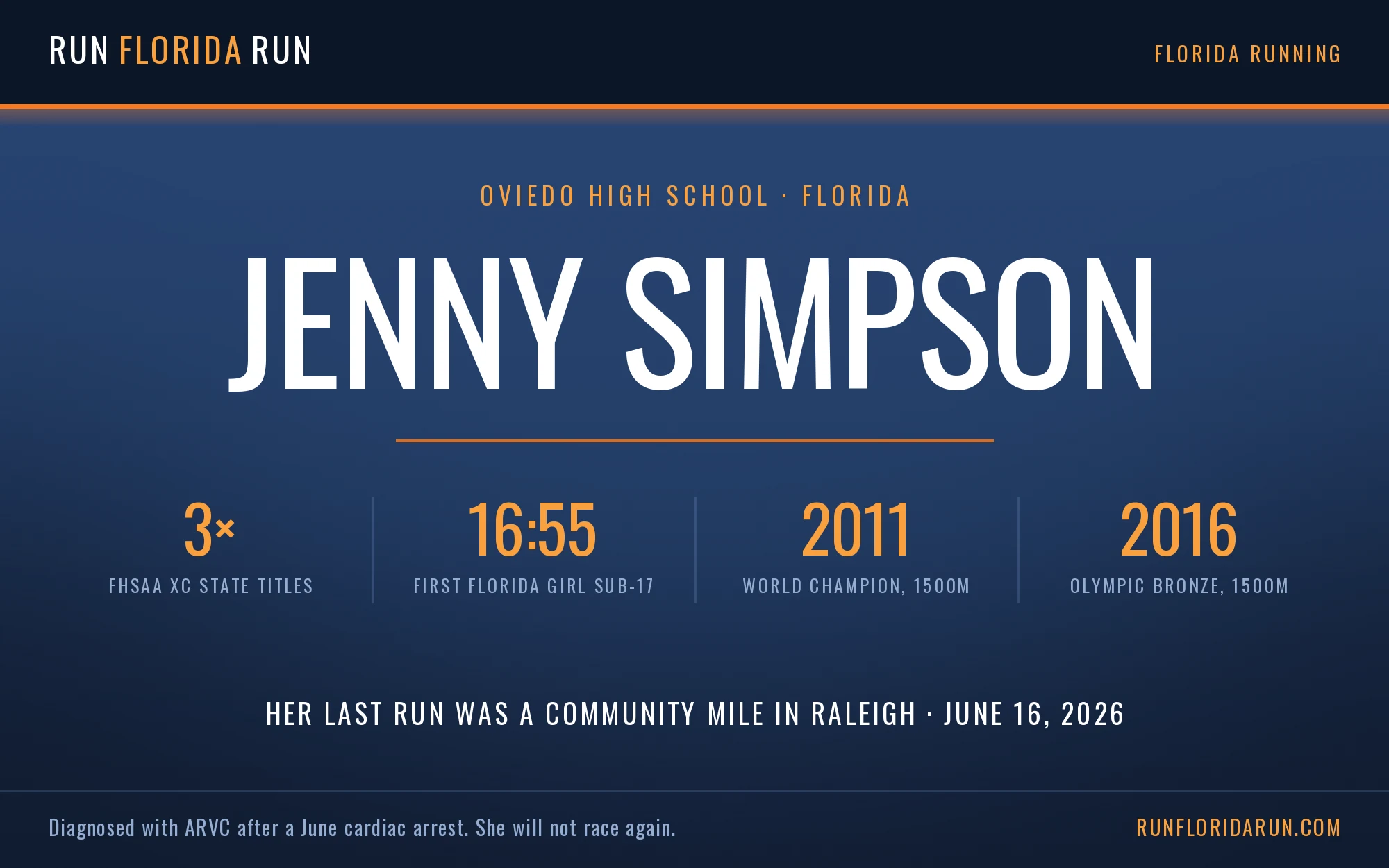
Florida's greatest high school distance runner went into cardiac arrest in June and has been diagnosed with ARVC. Her story, her Oviedo years, and what Florida's new EKG law means for the athletes racing this fall.
On August 20, Jenny Simpson told the running world that she is alive, that she is home, and that she will never race again.
The Olympic medalist and 2011 world champion posted a ten-slide account of what happened on the evening of June 16, after she paced a heat at the Sir Walter Running Pop-Up Mile in Raleigh, North Carolina. She went into sudden cardiac arrest. Bystanders started CPR and used an AED, and she was still alive when EMS arrived. At the hospital her heart stopped a second time. She was placed on life support, then transferred to Duke for advanced heart failure care.
She has since been diagnosed with arrhythmogenic right ventricular cardiomyopathy, or ARVC: an inherited condition in which scar and fatty tissue replace heart muscle and disrupt the heart's electrical system. It is one of the leading causes of sudden cardiac death in young athletes. It is also why her doctors have told her that running is no longer safe for her.
"That chapter has ended. Thankfully, my story hasn't," she wrote.
Jenny Simpson's August 20 announcement, posted to @trackjenny on Instagram.
Before she was Jenny Simpson, she was Jenny Barringer of Oviedo
Most of the country met her in a Colorado singlet, or in a USA vest on a world championship start line. Florida met her first.
She ran for Oviedo High School in Seminole County, and she was the best high school distance runner this state has produced. Three straight FHSAA cross country state championships, in 2002, 2003 and 2004. Five state track titles: the 1600 as a sophomore, then the 1600 and 3200 double as both a junior and a senior. Florida high school records in the mile, the two-mile, the 5,000 and the three-mile.
On November 1, 2003, under the lights at Ed Radice Park in Tampa, she ran 16:55 and became the first Florida girl ever to break 17:00 for 5K. She won that state title by more than a minute. She won Foot Locker South twice, in identical 17:27s, and took third in the country at Foot Locker Nationals in 2003 — still one of the best national finishes any Florida girl has ever managed.
In February 2018, Oviedo renamed its track after her. Kids who were not born when she ran 16:55 warm up on it every August.
What she did with it
At Colorado, she became the first woman to win three NCAA outdoor steeplechase titles, closing her college career with a 9:25.54 collegiate record in her final collegiate race and taking the 2009 Bowerman Award as the best track athlete in the country.
Two months later, at the 2009 World Championships in Berlin, she ran 9:12.50 in the steeplechase — an American record.
Then she moved down. In Daegu in 2011 she won the world title in the 1500 meters, the first American woman to win that event since Mary Decker in 1983. She added world silvers in 2013 and 2017. At Rio in 2016 she took bronze and became the first American woman ever to win an Olympic medal in the 1500. She was a three-time Olympian, an eight-time Fifth Avenue Mile champion including six straight from 2013 to 2018, and she ran 3:57.22 for 1500 meters and 4:17.30 for the mile.
She retired from professional racing after the 2024 New York City Marathon, spent a year running in all fifty states, and in February 2026 became Fleet Feet's first Chief Running Officer — the job she was doing in Raleigh in June.
Why this lands differently in Florida this fall
Simpson's diagnosis arrived in the same summer that Florida changed the rules for its own high school athletes.
The Second Chance Act (HB 1135 / SB 1070) took effect July 1, 2026. Beginning with the 2026-27 school year, every incoming ninth grader — and every 10th, 11th or 12th grader participating in an FHSAA-sanctioned sport for the first time — must have an electrocardiogram before competing. It is a one-time screening, not an annual one; returning athletes are encouraged but not required to get one. The FHSAA added an EL1 ECG screening form to the athletic clearance packet, and clearance registration opened May 25, 2026.
The law is named for Chance Gainer, an 18-year-old honors student and football player at Port St. Joe High School who collapsed and died of sudden cardiac arrest during a game in 2024. Screenings generally run $25 to $30; districts are directed to find low-cost partnerships, and a student is exempt if the district cannot obtain one for under $50.
So if your freshman is starting cross country this month and the physical packet looked different this year, that is why.
ARVC is exactly the category of condition an ECG is meant to surface — the telltale signs are things like T-wave inversion in leads V1 through V3, or premature ventricular complexes with a particular morphology. But it is worth being honest about the limits. The sensitivity of a 12-lead ECG for finding ARVC in young, asymptomatic people is not well established, and for a meaningful share of people who have it, sudden cardiac arrest is the first symptom. A screening is a real safety net with real holes in it.
The other half of the answer is whoever is standing there
Jenny Simpson is alive because of what happened in the next four minutes, not because of a form.
Someone at that track started compressions immediately. Someone got an AED on her fast. That is the entire difference between the update she posted in August and the one nobody would have gotten to read.
Florida already requires that infrastructure at its schools. The Zachary Martin Act, in effect since July 1, 2020, requires FHSAA member public schools to have an operational AED in a clearly marked, publicized location at every athletic contest, practice, workout and conditioning session — including out of season — and since June 1, 2021 requires a school employee or volunteer trained in CPR and AED use to be present at each event. A 2025 law, HB 1607, adds CPR and basic first aid instruction once in middle school and once in high school, requires district cardiac emergency response plans, and requires every public and charter school to have at least one operational AED on campus by July 1, 2027.
What none of that covers is the rest of the running life in this state: the Saturday morning group run, the summer time trial at the park, the neighborhood 5K. If you coach, lead a group, or direct a race, the two questions worth answering before your next one are where the nearest AED is and who present knows how to use it.
Where she is now
She is back in Colorado, still guided by her medical team at Duke, still finding out what recovery looks like over time. She is still Fleet Feet's Chief Running Officer, which means she will spend the rest of her working life getting other people into the sport she is no longer allowed to do.
Florida sends runners to the next level every year. Our boys and girls top 10s are full of them right now, and a few will run in college and beyond. None of them has done what the girl from Oviedo did, and it has been more than twenty years.
Her track is still there. Go run on it.